Introduction
It’s not easy to write a poem about a person who’s close to you. Possibilities such as over-sentimentality or, on the other hand, the likelihood that the subject could be offended, often abort such a would-be poem. In any case, the writer lives in hope that his/her efforts wouldn’t give cause for cringing.
In “My Sister, the Wild Beauty Motorhead Becomes a Homemaker”, Erin Macchiaroli bares her soul over her relationship with her sister, Farlae. She does so in a curious way, presenting a list of facts that builds up the story of their relationship. This cold delivery is at odds with the warmth we’d expect from a poem dealing with sisters.
Ultimately, a note of distance burns through in the relationship. There’s less admiration, and the disillusion that simmered under the surface before rises to the surface. This gives a satisfying end to the poem, I think. It’s brave. It’s honest. And it certainly doesn’t make us cringe.
My Sister, the Wild Beauty Motorhead Becomes a Homemaker
She asks me to lift one end of the table, and slides under it like a mechanic with the screwdriver aimed at the broken
leg.
She asked for tools for Christmas when she was nineteen.
She’s good at math.
My sister is a giant beauty. The one who will dance first.
The one who will dance with her arms in the air and her eyes closed.
She’s a magnet,
and demands eyes in waiting rooms and grocery stores.
She’s a homemaker now with two kids,
a boyfriend with an auto body shop,
and a pit bull eating the legs off her couch.
She cooks like a mom, giving herself to domesticity,
dumping a can of green beans into the pot,
turning the flame on high and walking away.
The chicken cutlets degrease on paper towels, getting cold on the counter.
This meal is the color of 1977.
She offers: bottled water, sugarless soda, decaffeinated coffee, or Heineken.
She’s playing Marvin Gaye on the radio in the kitchen. Some kid has a rubber hand expanding in a glass of water on
the shelf.
She gets her oil changed 3,000 miles on the nose.
She invited me over one day in August, and wasn’t home when I arrived
so I waited on her front stoop.
She rode up on a brand new motorcycle with a big smile
and a blonde ponytail sliding down her back.
My sister’s busyness, her completeness, her pride
And her way of installing ceiling fans impress me.
I think about her, and call long distance.
When I hear her voice (after six months,)
I wish I hadn’t.
She tells me to hold on, and without moving the phone from her face
directs the kids where to put away non-perishables, laughs at the dog ravaging a stuffed baby, and says
something/anything to her boyfriend calling him ‘babe’ all while I’m standing in my kitchen in Ireland alone, on
hold.
We will talk around the gaps, and the distance, and hope that somewhere in the dead air is a mutual feeling that we are
capable of more.
That would be enough.
It’s not easy to write a poem about a person who’s close to you. Possibilities such as over-sentimentality or, on the other hand, the likelihood that the subject could be offended, often abort such a would-be poem. In any case, the writer lives in hope that his/her efforts wouldn’t give cause for cringing.
In “My Sister, the Wild Beauty Motorhead Becomes a Homemaker”, Erin Macchiaroli bares her soul over her relationship with her sister, Farlae. She does so in a curious way, presenting a list of facts that builds up the story of their relationship. This cold delivery is at odds with the warmth we’d expect from a poem dealing with sisters.
Ultimately, a note of distance burns through in the relationship. There’s less admiration, and the disillusion that simmered under the surface before rises to the surface. This gives a satisfying end to the poem, I think. It’s brave. It’s honest. And it certainly doesn’t make us cringe.
My Sister, the Wild Beauty Motorhead Becomes a Homemaker
She asks me to lift one end of the table, and slides under it like a mechanic with the screwdriver aimed at the broken
leg.
She asked for tools for Christmas when she was nineteen.
She’s good at math.
My sister is a giant beauty. The one who will dance first.
The one who will dance with her arms in the air and her eyes closed.
She’s a magnet,
and demands eyes in waiting rooms and grocery stores.
She’s a homemaker now with two kids,
a boyfriend with an auto body shop,
and a pit bull eating the legs off her couch.
She cooks like a mom, giving herself to domesticity,
dumping a can of green beans into the pot,
turning the flame on high and walking away.
The chicken cutlets degrease on paper towels, getting cold on the counter.
This meal is the color of 1977.
She offers: bottled water, sugarless soda, decaffeinated coffee, or Heineken.
She’s playing Marvin Gaye on the radio in the kitchen. Some kid has a rubber hand expanding in a glass of water on
the shelf.
She gets her oil changed 3,000 miles on the nose.
She invited me over one day in August, and wasn’t home when I arrived
so I waited on her front stoop.
She rode up on a brand new motorcycle with a big smile
and a blonde ponytail sliding down her back.
My sister’s busyness, her completeness, her pride
And her way of installing ceiling fans impress me.
I think about her, and call long distance.
When I hear her voice (after six months,)
I wish I hadn’t.
She tells me to hold on, and without moving the phone from her face
directs the kids where to put away non-perishables, laughs at the dog ravaging a stuffed baby, and says
something/anything to her boyfriend calling him ‘babe’ all while I’m standing in my kitchen in Ireland alone, on
hold.
We will talk around the gaps, and the distance, and hope that somewhere in the dead air is a mutual feeling that we are
capable of more.
That would be enough.
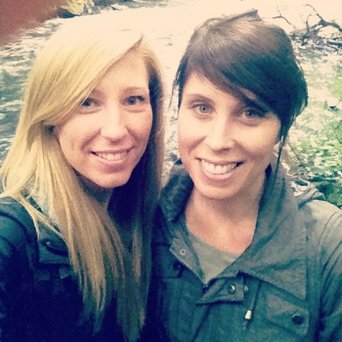
Erin (on the right) and her sister Farlae
About Erin
I am a 36-year-old New Yorker who graduated from the NUI Galway MA in Writing program in 2009. I currently work for a non-profit environmental organization in Beacon, NY. After finishing my MA in Galway I spent the next five years living out a dream – seaside in Kinvara mastering the back roads of Clare. I co-hosted a radio show called Sunday Best on the now defunct Rascal Radio out of Co Mayo. My poems have been featured in Three Times Daily, The Clare Champion and Chronogram Magazine. Since returning to NY in 2013, I turned my attention to script writing, and am co-writing a series titled Home. I live with my new husband Robert on the banks of the Hudson River in Newburgh, NY.
Interview
I have to ask: what is the colour of 1977?
1977 is the faded autumnal colors of the afghan blankets my grandma crocheted in the 70s. A lot of our family photos feature her blankets draped over the back of a couch, spread across the foot of a bed or wrapped around a baby.
I just realized that Instagram has a “1977” filter! My grandma would be happy.
You paint a vivid portrait of the sister here. What I find particularly interesting and unusual about it is how you did so in such a matter-of-fact tone. Separate pieces of information are placed beside each other, creating some kind of mosaic in the reader's mind. Did you aim to reflect anything specific with this approach or did it just come out that way?
It just came out that way. I write most of my poems as an observer. It takes some distance before I can work my way towards the final moments of hope/truth/acceptance.
The distance is palpable here, both physically and in terms of the sibling relationship. Do you think the physical distance has caused the emotional distance in any way, and was this connection behind the inspiration for the poem? Or would you cite something else as causing it?
Years of physical distance can do many things to a relationship. In this case, we lost touch. On the rare occasions when we did talk, the contrast between our lives felt sharp. She was a busy mother and homemaker, and I was a writer living on my own in a rented cottage in Kinvara.
Ireland is a country of families, cousins, and uncles’ neighbors. I remember trying on clothes at the Dunne’s store in Ennis, and I could hear the other women in the dressing rooms. I could tell that they were sisters, and I think that’s what did it. I had to return to New York because I wanted to hear my sister’s voice through the walls of a dressing room.
Your poem presents the metamorphosis of a character/person. Do you see metamorphosis lurking behind many of your poems, or even behind poetry in general?
Absolutely. My writing likes to find its way towards the light.
Why do you write?
With poetry, I write because it’s the only way I can hold onto and share something fleeting. With script writing, I write because I like to present relatable characters, send them off on a path and see how they’ll hold up in the world.
If you had one piece of advice for a writer, what would it be?
My only simple “advice” would be to know that you are unique. There are no two of us the same. Keep writing in your own way and make it part of your routine.
If nothing else, writing is your gift to yourself, but share it when you can.
About Erin
I am a 36-year-old New Yorker who graduated from the NUI Galway MA in Writing program in 2009. I currently work for a non-profit environmental organization in Beacon, NY. After finishing my MA in Galway I spent the next five years living out a dream – seaside in Kinvara mastering the back roads of Clare. I co-hosted a radio show called Sunday Best on the now defunct Rascal Radio out of Co Mayo. My poems have been featured in Three Times Daily, The Clare Champion and Chronogram Magazine. Since returning to NY in 2013, I turned my attention to script writing, and am co-writing a series titled Home. I live with my new husband Robert on the banks of the Hudson River in Newburgh, NY.
Interview
I have to ask: what is the colour of 1977?
1977 is the faded autumnal colors of the afghan blankets my grandma crocheted in the 70s. A lot of our family photos feature her blankets draped over the back of a couch, spread across the foot of a bed or wrapped around a baby.
I just realized that Instagram has a “1977” filter! My grandma would be happy.
You paint a vivid portrait of the sister here. What I find particularly interesting and unusual about it is how you did so in such a matter-of-fact tone. Separate pieces of information are placed beside each other, creating some kind of mosaic in the reader's mind. Did you aim to reflect anything specific with this approach or did it just come out that way?
It just came out that way. I write most of my poems as an observer. It takes some distance before I can work my way towards the final moments of hope/truth/acceptance.
The distance is palpable here, both physically and in terms of the sibling relationship. Do you think the physical distance has caused the emotional distance in any way, and was this connection behind the inspiration for the poem? Or would you cite something else as causing it?
Years of physical distance can do many things to a relationship. In this case, we lost touch. On the rare occasions when we did talk, the contrast between our lives felt sharp. She was a busy mother and homemaker, and I was a writer living on my own in a rented cottage in Kinvara.
Ireland is a country of families, cousins, and uncles’ neighbors. I remember trying on clothes at the Dunne’s store in Ennis, and I could hear the other women in the dressing rooms. I could tell that they were sisters, and I think that’s what did it. I had to return to New York because I wanted to hear my sister’s voice through the walls of a dressing room.
Your poem presents the metamorphosis of a character/person. Do you see metamorphosis lurking behind many of your poems, or even behind poetry in general?
Absolutely. My writing likes to find its way towards the light.
Why do you write?
With poetry, I write because it’s the only way I can hold onto and share something fleeting. With script writing, I write because I like to present relatable characters, send them off on a path and see how they’ll hold up in the world.
If you had one piece of advice for a writer, what would it be?
My only simple “advice” would be to know that you are unique. There are no two of us the same. Keep writing in your own way and make it part of your routine.
If nothing else, writing is your gift to yourself, but share it when you can.
 RSS Feed
